
Previous Residents at a Swatara Township Address
Start with the source that fits the period, rather than assuming one record names every past household. Dauphin County assessment data provide a current parcel starting point. The Recorder then supplies recorded ownership history. Historic directories and federal census schedules can add a dated household clue, while Township permits and plans can place construction or a project at an address without identifying everyone who lived there. The county trail is especially useful in Swatara Township because property records can lead backward through older legal descriptions even when a modern street number does not.
| Source | Years it covers | Where held | What it shows |
|---|---|---|---|
| Recorder deeds and miscellaneous records | 1785 to present | Dauphin Recorder Acclaim index and courthouse | Recorded transfers, parties, and legal descriptions |
| Recorder mortgage records | 1979 to present | Dauphin Recorder | Recorded mortgage, assignment, release, or satisfaction trail |
| HSDC Harrisburg directories | 1839 to 1999, with documented gaps | Alexander Family Research Library | Dated name, address, and usually occupation, subject to volume scope |
| East Shore directory microfilm | 1861 to 1901 | Dauphin County Library System | On-site directory cross-check |
| Federal census | 1790 to 1950 released, except 1890 | NARA and archive access channels | Household composition at an enumeration date |
| Township permits and plans | Published historic range not located | Building & Codes, counter, or RTKL request | Address, project, construction, use, or plan-date evidence |
A present owner is not automatically a past occupant, and a directory entry is not title proof. Use the property trail to anchor the parcel, then put dated household sources beside it. For older material that does not appear online, the Recorder counter, the East Shore microfilm room, the Historical Society, and the State Archives are separate access channels, not interchangeable copies of one database.
Note: Older deeds can use a lot, plan, rural route, or legal description instead of the current street number.
Swatara Township Previous Residents by Parcel
A Dauphin Property ID, also called a UPI or Uniform Parcel Identifier, stays with a parcel even when ownership changes. That makes it the most reliable bridge from a Swatara Township site address to the assessment record, map feature, recorded deed, plan, and legal description. Search the Dauphin County Property Tax Inquiry by parcel, owner name, or house number and street. The County advises using the street name without directional wording or a suffix in its simple search tip. Select Swatara Township in the municipality field when a broad result needs narrowing.
Capture the property ID, site address, current owner, separate mailing address, deed reference, and sale information when displayed. The mailing field is correspondence data, not evidence that its recipient lived at the property. The same restraint applies to a current owner name. It does not identify all past residents or establish that an owner occupied the site. The in-office assessment record card can add lot, building sketch, room, bath, and feature details that are not promised in every web result.
- Property ID / UPI
- A county identifier for one tract, lot, or parcel. It remains the stable link when names change.
- Situs address
- The address of the parcel itself. It is different from a tax mailing address.
- Legal description
- The deed's parcel description, often using lots, plans, bearings, or boundaries rather than a modern street label.
Swatara Township Prior Deed Chains
The Dauphin County Recorder of Deeds is the county custodian for the recorded transfer trail. In the Acclaim index, an address normally becomes useful only after the assessment result supplies an owner, UPI, book and page, or instrument reference. Acclaim provides Name, Instrument Number, Document Type, Book/Page, Record Date, Consideration, UPI Number, Municipality/Comments, and Alpha Index routes. The original record remains authoritative at the Recorder office, so a web hit is the start of review, not the last word.
The Recorder's public coverage reaches deeds and miscellaneous documents from 1785 to the present. Mortgage coverage begins in 1979. That long span is valuable for previous residents research, but it does not make a present street number searchable across every era. A subdivision, merger, new address, or older plan can break a simple address search. Carry the parcel identifier, plan name, lot or block, legal description, and prior document reference at every step.
The Recorder's official page explains its record access and counter service.
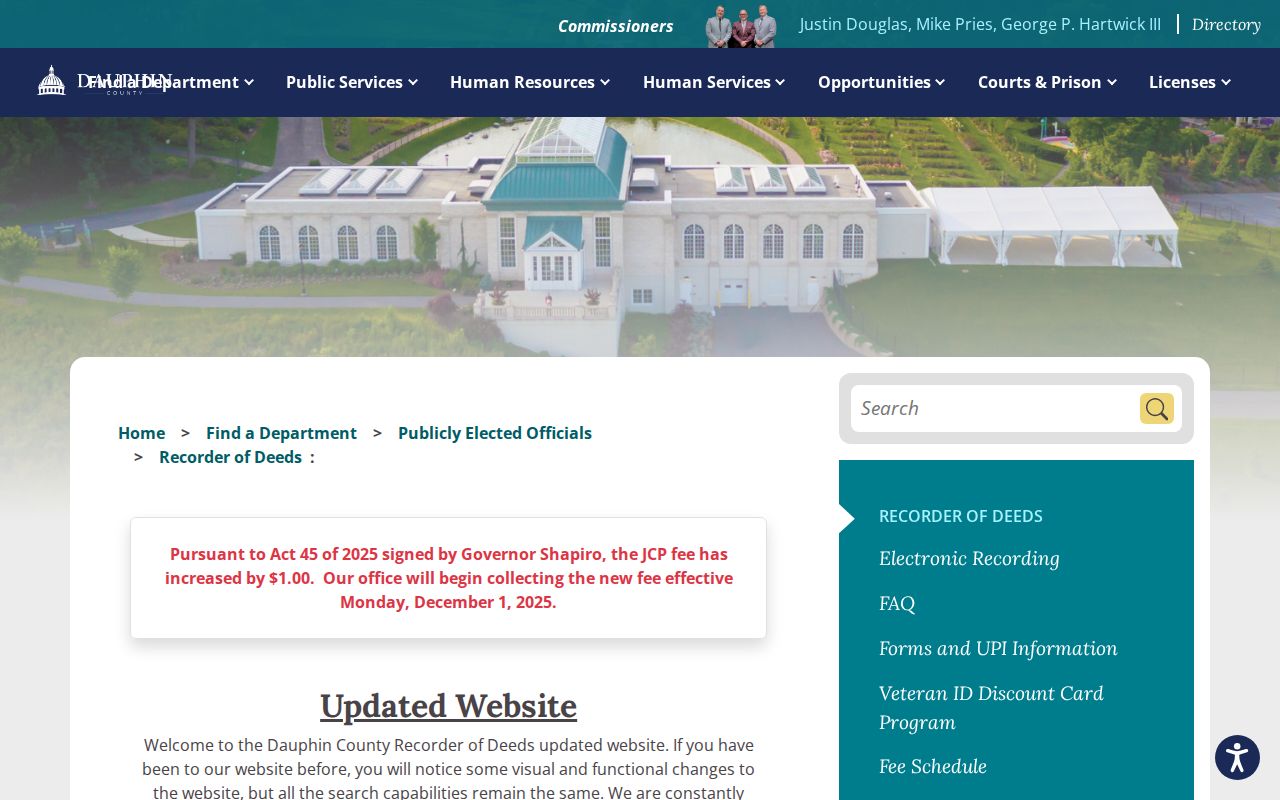
Use the Recorder image as a reminder to check the indexed transfer against the actual record route or courthouse counter when a chain needs confirmation.
- Find the current parcel in Property Tax Inquiry and record the UPI, owner, deed reference, and legal description.
- Search the current owner as a grantee, or use the known UPI, book and page, or instrument number in Acclaim.
- Read the transfer record for the grantor, the person or party conveying the property, and preserve its legal description.
- Search that prior owner as a grantee to find the acquisition into that ownership, then repeat backward.
- When the web index cannot resolve a detail, use the Recorder counter or Alpha Index rather than guessing from an address match.
- Grantor
- The party transferring an interest in a recorded document.
- Grantee
- The party receiving that interest. Searching a prior owner as grantee can locate an earlier purchase.
- Chain of title
- The sequence of recorded transfers connecting one ownership period to an earlier one.
Swatara Township Past Residents in Directories
The household layer needs dated sources. The Historical Society of Dauphin County keeps a long but gapped Harrisburg City Directory run from 1839 through 1999, while the East Shore Area Library holds Harrisburg directories on site for 1861 through 1901. Those are Harrisburg-area collections that can include nearby places. A volume titled Harrisburg is not proof that every Swatara Township address appears in it. Check the title page, geographic scope, alphabetical section, and any street-number section before calling a name absent.
Some historical volumes have a second listing by street number. That useful quirk can turn an old address into a lead, but only in the volumes that actually contain it. HSDC describes ordinary entries as name, address, and usually occupation; it does not establish a uniform spouse, renter, widow, or abbreviation convention. The collections themselves are described in more detail in the Swatara Township Directory Book.
The State Archives county digitized-records guide explains how researchers reach public-search-room and microfilm material.
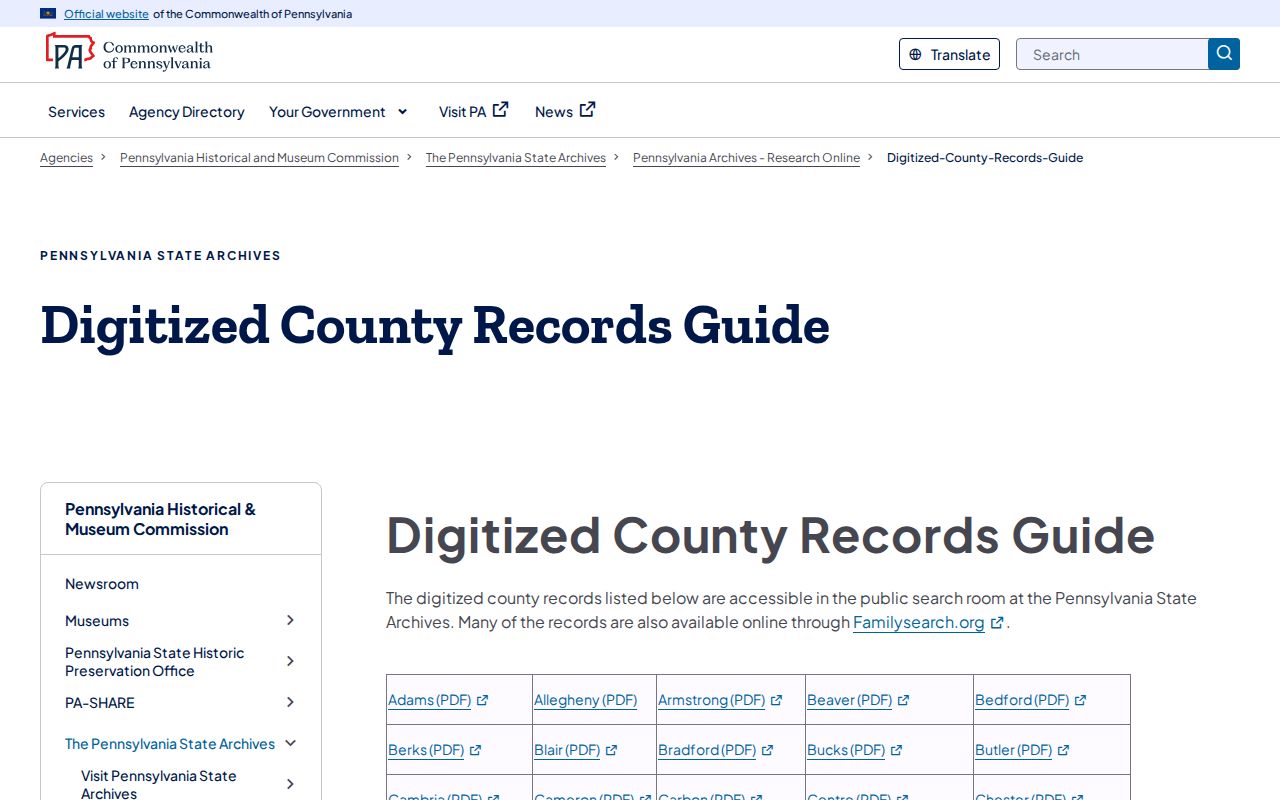
The guide supports an archive fallback when an online deed index or directory shelf does not answer a Swatara Township address question.
Swatara Township Previous Residents and Census
Pair a directory year with the closest released federal census rather than treating either record as complete by itself. A directory can supply a spelling and address clue. A census can test whether a household was recorded in the township at its enumeration date. The latest released federal census is 1950. Pennsylvania archival guidance identifies federal population schedules from 1790 through 1930, with a national gap for 1890 because most of that census was destroyed in a 1921 fire.
A simple pairing process keeps the dates honest:
- Copy the surname, initials, street address, and edition year exactly as printed in the directory.
- Check whether that volume includes the relevant Swatara or nearby postal area before drawing any conclusion.
- Compare the nearest released census, using the township and household structure as a cross-check.
- Where 1890 would be the next comparison, move to the next available directory, newspaper, deed, probate, church, or cemetery source instead.
The Dauphin County Library System collection adds on-site Patriot-News microfilm for 1946 through 2015. Notices or obituaries can help explain a move, death, or name change after a dated directory reference, but they should still be compared with the official property or estate record.
Swatara Township Prior Permit Dates
Township records can add a construction, alteration, zoning, stormwater, street-opening, subdivision, or land-development date to a house history. Swatara Building & Codes publishes the permit and application categories, and active-development materials show that some planning records use an address or project label. A permit proves that an application or record is tied to the property at that time. It does not prove that the applicant or owner was the person living there.
No official searchable Township permit database was located. The documented fallback is a narrowly written request for existing, dated permits, plans, certificates, or file numbers for a particular address through the Township's Right-to-Know process, an inspection request, or the Planning and Zoning counter. The Township says requests must describe existing records with enough specificity, and that questions are not records requests. Compare a returned date with the deed chain, assessment year-built information, and historical sources.
Note: A plan or permit is address evidence, not a public list of everyone who lived at the property.
Swatara Township Previous Residents and Estates
Estate and probate records can supply an official family-history route when a former owner or household member has died. The Dauphin Register of Wills and Clerk of the Orphans' Court holds estates from the late 1700s to the present, inheritance-tax dockets from 1917, and historic Orphans' Court material. Its public-record and Cloud Search routes may help locate a record reference, while Room 103 at the courthouse remains the counter route. Restricted adoption and guardianship material must not be assumed public.
For historical vital seams, Dauphin holds county birth and death records from 1893 through 1906, and the Pennsylvania Department of Health holds Commonwealth birth and death certificates from 1906 forward. Public access dates and eligibility rules differ by record and year. The Pennsylvania Vital Records genealogy information explains the archival route.
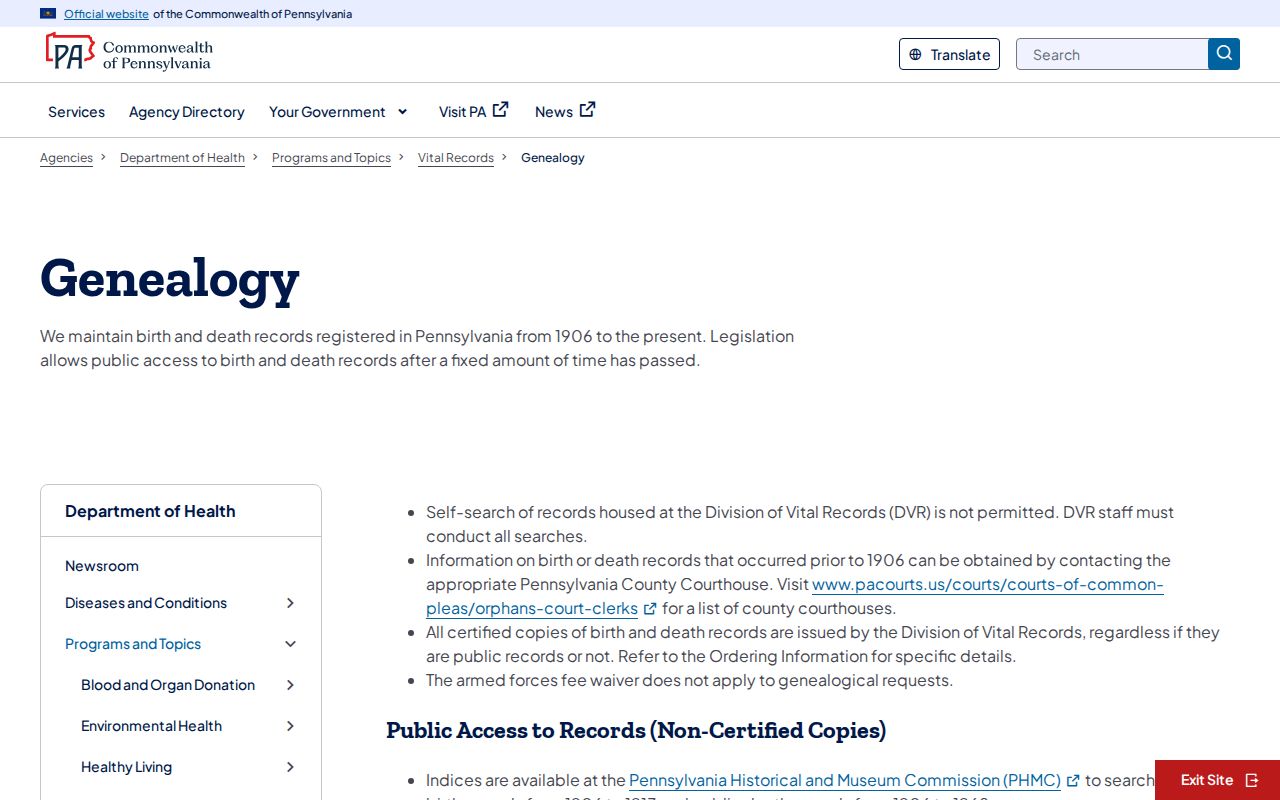
Use a vital or estate record as a date-specific family-history lead, then return to the county custodian for the appropriate official record or copy process.
Swatara Township Archive Sources for Past Residents
When a trail reaches a gap, the Historical Society of Dauphin County offers a documented local-history fallback. Its Alexander Family Research Library holds directories, clippings, church and cemetery records, county histories, selected Harrisburg Sanborn maps, school yearbooks, will extracts, Orphans' Court extracts, atlases, and family material. It also offers paid on-site librarian research. The East Shore library provides a second in-person channel for directories and newspapers, while the State Archives' Dauphin guide identifies county microfilm and naturalization material.
A Swatara-specific house-history guide or verified Township Sanborn run was not located in the official sources. Ask HSDC or the State Library to confirm coverage for a particular street before relying on a map title or year. Harrisburg postal labels can also appear in records for a Township address, so separate the postal city from the municipality when assessing a historical match.
Lawful Swatara Township Previous Resident Research
House and family history work should stay tied to a legitimate record question. A missing public result can reflect an address change, a record outside the available series, a restricted record, or a protected address. It is not proof that someone never lived there or cannot be reached. Pennsylvania's Address Confidentiality Program can lawfully substitute an address in several public systems for eligible participants, and its protections should not be worked around.
Lawful use. Use Swatara Township previous residents research for house history, family history, estate work, or personal record verification. Do not use a record trail to track, harass, threaten, or harm a living person.